Scientists in Vienna Built the First Nuclear Clock That Keeps Itself on Time
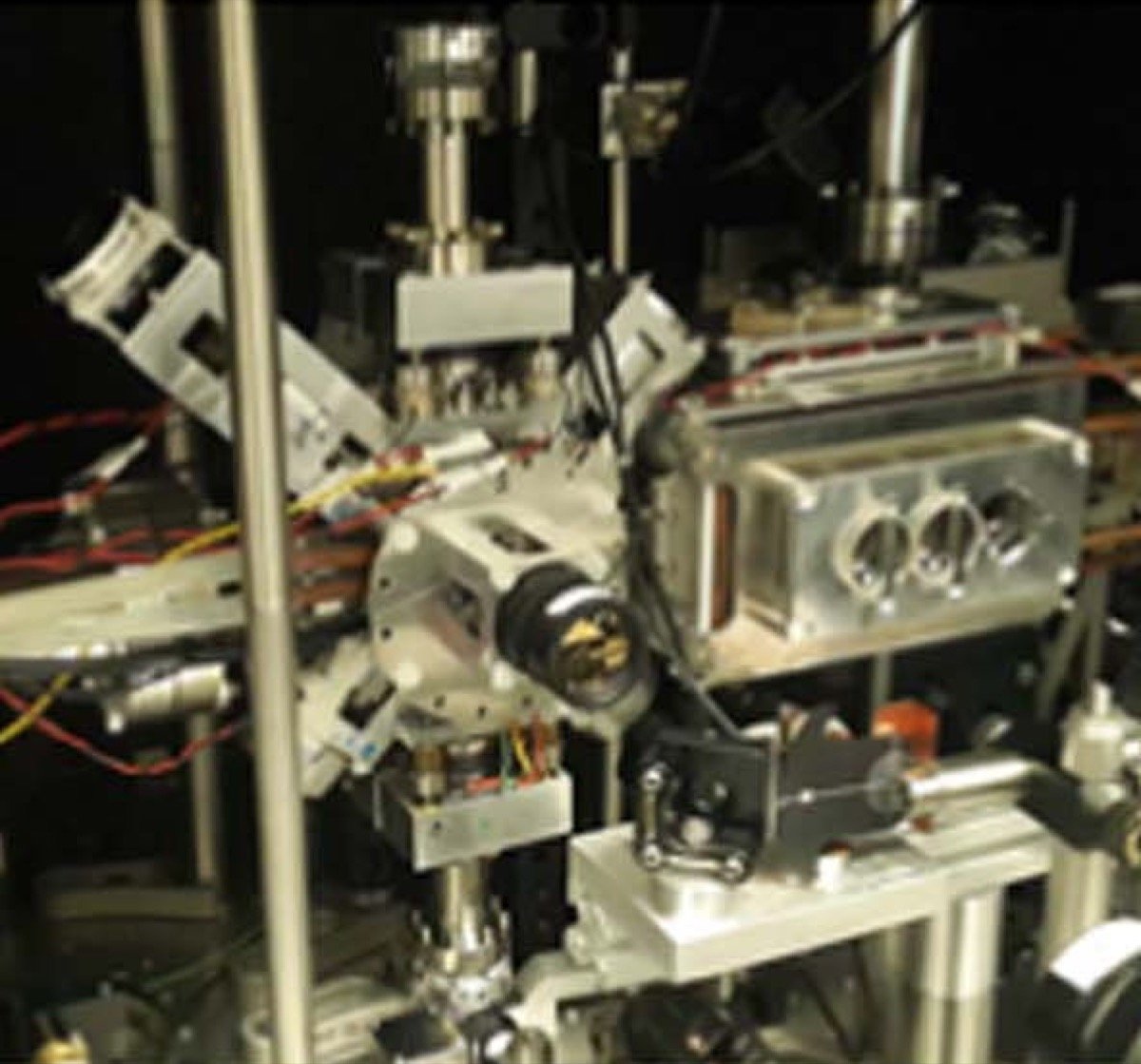
Physicists at TU Wien in Vienna, working with Germany's national metrology institute PTB, have demonstrated what they describe as the world's first self-stabilising nuclear clock. Based on the atomic nucleus of thorium-229, the prototype ran for more than 24 hours without anyone touching it, with a relative accuracy of about 10-15, roughly one second of error in 30 million years.
That doesn't yet beat today's best optical atomic clocks. But it's the first time a clock ticking on a nucleus, rather than on electrons, has kept itself locked on time, a milestone physicists have chased for decades.
For 70 years, the world's most precise clocks have ticked to the rhythm of electrons. Now a team in Vienna has built a clock that ticks to the rhythm of an atom's nucleus, and, for the first time, keeps itself on time without help.
The prototype, built at TU Wien with Germany's national metrology institute PTB, uses thorium-229 atoms held inside a specially grown crystal. A laser shines on the crystal, and the thorium nuclei absorb its light only at one exact frequency. A feedback loop constantly checks how much light is being absorbed and corrects the laser whenever it drifts. The result is a laser locked to a frequency set by nature, and counting that frequency gives you time.
In tests, the clock ran for more than 24 hours with no human intervention. Over that day, its relative accuracy was about 10-15, which corresponds to an error of about one second in 30 million years. The researchers describe their work in a preprint on arXiv.
Not the most accurate clock, yet
That sounds astonishing, but the best optical atomic clocks are already far better, reaching around 10-18 or beyond. The Vienna clock isn't about beating them today. It proves that the long-predicted idea of a nuclear clock actually works as a continuously running device.
The promise is in the physics. A nucleus is about 100,000 times smaller than an atom and sits shielded by its electrons, so in principle it's much less disturbed by the outside world. That could eventually allow clocks that are more stable, and potentially small and solid-state rather than room-sized laboratory setups.
Why it matters
Precise time quietly runs modern life: GPS positions, mobile networks, power grids and stock exchanges all depend on it. Beyond that, physicists want nuclear clocks as instruments, because the thorium transition is extremely sensitive to tiny changes in the fundamental constants of nature. A nuclear clock could help test whether those constants drift over time, or reveal signs of dark matter.
A separate team at Tsinghua University in China has also demonstrated a thorium-229 nuclear clock, a sign of how fast this field is now moving after decades of slow progress.
Key Details
- Who: TU Wien (Vienna) with PTB, Germany's national metrology institute
- What: A clock locked to a transition in the thorium-229 nucleus
- Run time: More than 24 hours without human intervention
- Relative accuracy: About 10⁻¹⁵, roughly 1 second in 30 million years (an estimate from a day of measurements)
- Best optical clocks today: Around 10⁻¹⁸ to 10⁻¹⁹, still far more accurate
- Paper: arXiv preprint 2606.04997
Technical Analysis
Every clock counts something that repeats. A quartz watch counts a vibrating crystal; an atomic clock counts the frequency of light that makes an atom's electrons jump between energy levels. A nuclear clock counts a jump inside the atom's nucleus instead.
Thorium-229 is special because its nucleus has an unusually low-energy excited state that can be reached with ultraviolet laser light, something no other known nucleus allows. In the Vienna setup, thorium atoms are embedded in a crystal grown at TU Wien and lit by a laser. The nuclei absorb light only at one precise frequency. If the laser drifts, absorption drops, and a feedback loop nudges the laser back. Counting that locked frequency is the clock.
Because the nucleus is tiny and shielded by its surrounding electrons, it should be far less disturbed by stray electric and magnetic fields than electrons are. That's why physicists hope nuclear clocks could eventually beat atomic clocks, and could be built into robust solid-state devices rather than complex vacuum systems.
Expert Analysis
The result should be read for what it is: a working prototype, not a record-breaking clock. Its accuracy of about 10-15 is roughly a thousand to ten thousand times worse than the best optical atomic clocks. The "one second in 30 million years" figure is an extrapolation from a day of measurement, not a test lasting millions of years. A separate team at Tsinghua University in China has independently demonstrated a thorium-229 nuclear clock, so the field is moving quickly on more than one front.
Historical Context
Thorium-229's unusual nuclear state was predicted in the 1970s, but pinning down its exact energy took decades. In 2024, teams including TU Wien and JILA in the US finally excited it directly with a laser and measured its frequency precisely, the step that made a working nuclear clock possible. This year's prototype is the first to close the loop and run continuously.
Future Outlook
The following is analysis and prediction, not confirmed fact.
Better clocks matter well beyond timekeeping. They underpin GPS, telecom networks and financial timestamps, and ultra-precise clocks are used to test whether the constants of nature are really constant, or to search for dark matter. Because the thorium transition is unusually sensitive to some of those effects, even a less accurate nuclear clock could make new physics measurements. Turning it into a practical device will take years.
Key Takeaways
- TU Wien and PTB demonstrated the first self-stabilising nuclear clock, based on thorium-229.
- It ran for over 24 hours unattended, with accuracy of about one second in 30 million years.
- It is not yet as accurate as the best optical atomic clocks.
- Nuclear clocks could one day be more robust and precise, and could probe new physics.
Frequently Asked Questions
What is a nuclear clock?
A clock that keeps time using the frequency of light absorbed by an atom's nucleus, rather than by its electrons as in atomic clocks. Thorium-229 is the only known nucleus suitable for this with lasers.
Who built the first self-stabilising nuclear clock?
Researchers at TU Wien in Vienna, working with Germany's PTB metrology institute. Their thorium-229 prototype ran on its own for more than 24 hours.
Is the nuclear clock more accurate than atomic clocks?
Not yet. The prototype's accuracy is about 10⁻¹⁵, while the best optical atomic clocks reach around 10⁻¹⁸ to 10⁻¹⁹. Nuclear clocks may eventually surpass them.
Why are nuclear clocks important?
They could be more stable and compact than atomic clocks, improving navigation and communications, and they are very sensitive tools for testing fundamental physics.
Source: arXiv: A thorium-229 optical nuclear clock with feedback loop, Interesting Engineering